
Last Updated on July 15, 2026
Getting your article ranked higher in the search engine results isn’t just about hitting the “publish” button and hoping for the best.
Every day, around 7.5 million blog posts are published, but only a small fraction actually achieve higher rankings in SERPs.
Wondering why?
Well, the answer lies in optimization. No matter how well-written and unique your article is, if it isn’t optimized according to the needs of search engines, it may not be able to dominate the rankings.
That’s why understanding how to effectively optimize your article is no longer optional; it is essential.
In this post, we will share some helpful tips that can be followed to optimize the article for SEO.
Tips to Optimize Article for Improved SERP Visibility:
Here are a few useful tips that will help you optimize an article for enhanced visibility in search engine results:
1. Understand search intent & align content with it
Instead of immediately starting the article optimization process, it’s important to understand the search intent of the topic. Search intent is basically the primary objective for which a user is performing a search online.
It is usually categorized into four main types:
- Informational – The user is looking for information to improve their knowledge and solve problems.
- Navigational – The user is looking for a certain website or webpage.
- Commercial – The user is finding products/services, but has not made the final decision regarding the purchase.
- Transaction – The user is ready to make the purchase or take a specific action.
For example, if someone is searching for “how to optimize a blog,” then the intent is “Informational.” They expect a guide, not a promotional page.
When it comes to aligning your article with search intent, you simply need to analyze the top-ranking competitors to determine the information, format and tone. When done, tailor your article optimization approach accordingly.
2. Research & add different types of keywords
It is 2026, and keywords still matter. These are specific words and phrases that tell search engine crawlers what the content is about. However, their concept has changed from exact match phrases to different combinations that support user intent.
Now, to optimize the article, you should research and add:
- Primary keywords
- Secondary keywords
- Long-tail keywords
- Semantic keywords
On the internet, there are numerous tools available, such as Semrush that can help in keyword research. This tool provides a list of combinations along with their volume and difficulty, making it easier for you to choose the appropriate ones.
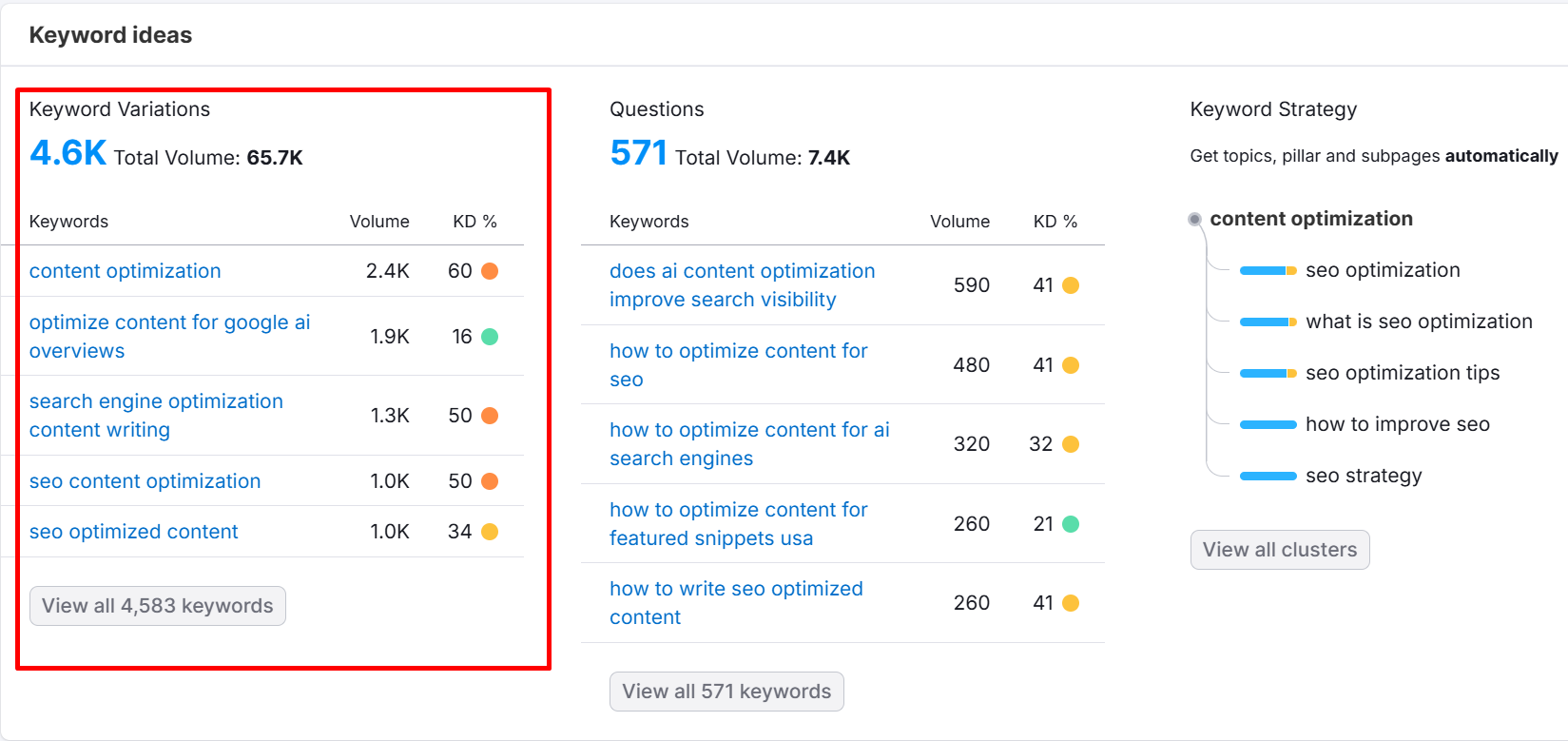
Tool link: semrush.com
You should strategically incorporate the keywords throughout the article to get the most out of them. Here is a breakdown of their usage:
- Use the primary keyword in the title, main introduction, main headings, and conclusion
- Use secondary ones throughout the body
- Use long-tail keywords in FAQs and sub-headings, if possible
Avoid overusing keywords in the pursuit of quick rankings. This practice is known as “keyword stuffing,” and is considered a black-hat optimization strategy by Google.
3. Make title SEO friendly
The title is one of the first things that crawlers review when evaluating your article for rankings. It plays an important role in telling both the audience and search engines what the topic is about and drives clicks.
For this reason, it is essential to optimize your article title as well, so that it can outrank others. Here are things that should be done in this regard:
- Must use the primary keyword
- Keep it relevant and clear
- Use numbers and powerful words
- Restrict its length between 50 and 60 characters
For example, titles such as “Useful Tips to Optimize Article for Better Rankings” are more likely to perform well in the SERPs. This is because it is relevant, clear, and has appropriate length.
So, a well-optimized title not only helps with SEO but also improves user engagement, which is crucial for better rankings.
4. Fix Readability and Tonal Consistency Issues
If your article has readability and tonal consistency issues, it may not be able to engage the audience. This will send a bad signal to the search engine, resulting in lower visibility in the SERPs.
To achieve optimization, it is important to fix both clarity and tone issues. Try to replace complex or technical words with simpler, more familiar terms that are easier for a wider audience to understand.
Also, eliminate any unnecessary or filler words, and break long sentences into shorter ones.
When it comes to maintaining a consistent tone, you have to do the following:
- Avoid shifting from formal to informal language and vice versa.
- Prefer the active voice mostly.
- Pay attention to perspective as well. For example, if your article is written in a second-person tone, then follow it throughout the article.
We know that improving readability and maintaining a consistent tone requires both time and effort, along with a strong command of writing skills.
If you lack any, don’t get worried, as AI Paraphraser can offer assistance. It rephrases text to improve clarity and offers different modes to adjust tone/style.
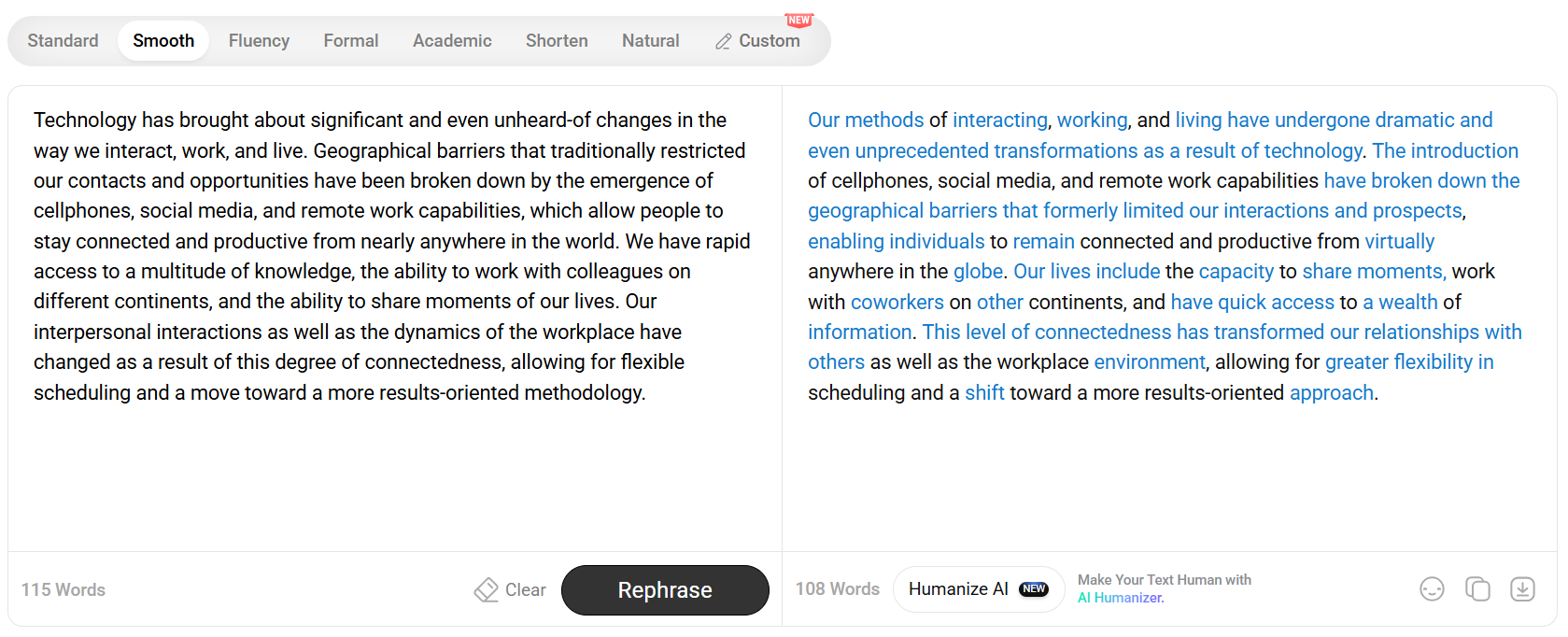
Tool link: https://www.summarizer.org/paraphrasing-tool
An article with good readability and a consistent tone appears more polished and professional. This not only improves the reader’s experience but also increases its chances of ranking higher in search results.
5. Add Internal and External Links
Inserting links within your article improves both its SEO and user experience.
Internal links redirect the user from one webpage to another page of the same site. These help the search engine to discover and crawl other pages of your site for better rankings.
So, you should add relevant internal links to your article. The number of links usually depends on the word count. If the article has 1,000 words, a few relevant internal links are usually enough.
When it comes to external links, they work the opposite way by redirecting the user to other websites. Adding external links within your article signals Google that the content is well-researched and trustworthy.
For this reason, it is suggested to only add external links to websites that are actually considered credible and authoritative.
Read our blog post on: What is Link Strength?
6. Optimize Visuals
Visuals such as images, videos, or infographics make the article appealing and easier to read. Apart from that, visuals, especially images, also rank in SERP.
Adding high-quality photos, especially editorial news and sports photos, can significantly boost your search rankings. This is particularly important in news style articles, where timely, authentic imagery strengthens both credibility and engagement.
However, optimization is the key here as well, and if they aren’t optimized properly, they may negatively affect your page performance. Users can also explore nano banana models to check and see how different models generate visuals, helping them better understand optimization choices.
Below, we have listed a few things that you should do to achieve optimization.
- Compress images and infographics to reduce their size
- Add alternative text for images.
- Compress videos as well, if there are any. Host them externally on platforms like YouTube, instead of directly uploading from your server.
- Use relevant file names when adding visuals in the article
These are a few essential tips that can help optimize the article for better ranking in the SERPs.
Final Words
Simply creating and publishing a unique and valuable article is not enough to dominate the search engine results. You need to optimize it according to SEO best practices.
To do so, there are multiple tips you can follow, such as aligning your content with search intent, adding a combination of keywords, fixing clarity issues, and much more.
This blog post has discussed all these essential tips in complete detail.