
Last Updated on August 18, 2026
In digital marketing , video has become one of the most effective formats for engagement, education, and conversions. But as video usage grows, marketers also need ways to confirm that content is authentic and properly sourced. This is necessary to avoid problems with copyrights and/or using problematic videos.
Whether you are working with influencer content, campaign assets, or user-generated media, you need to have a video verification process in place.
Verification processes can catch problematic videos before they are published. So, they are necessary to protect your brand’s credibility.
Strong processes reduce the publishing risks and help maintain audience trust. Even a single misleading video can damage campaign performance and affect how audiences perceive a brand. So, in-depth verification is critical.
Today, we are going to discuss some tips and techniques to empower your video verification workflows.
1. Verify Video Sources with Reverse Video Search
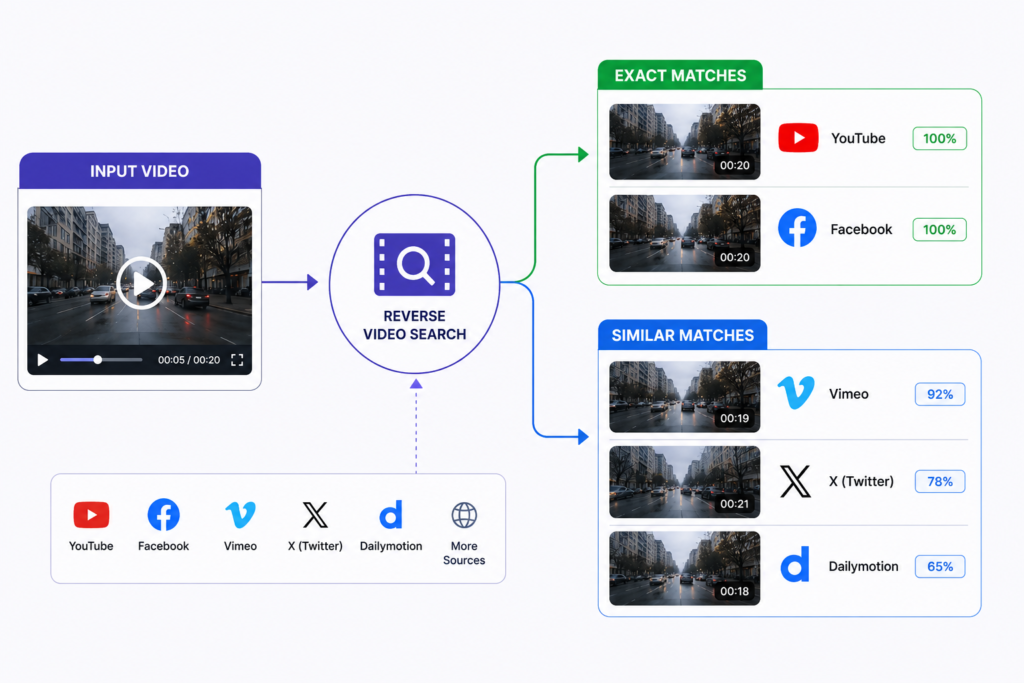
One of the most effective ways to verify a video is to identify where it originated and whether it has appeared elsewhere online. As you know, in the age of social media, content is frequently reposted and shared across platforms.
Videos are one of the most frequently reposted items across multiple platforms. Many times, they aren’t even altered that much. Usually, what usually changes are the descriptions or publication dates. Oftentimes, they are reused without proper attribution.
So, if you are trying to use UGC (user-generated content) or have some videos made for your brand from a 3rd party (i.e., a freelancer), it is recommended that you do a reverse video search first.
Reverse video search helps marketers:
- Find other appearances of a video online. This includes both exact matches and similar videos.
- Identify duplicate uploads
- Discover reused or unattributed content
- Check if the content is out of context
- Confirm whether the publishing source appears legitimate
This process becomes especially useful when evaluating influencer submissions, user-generated content, or externally sourced campaign assets.
Using a dedicated video verification tool such as Revideo allows marketers to trace video appearances more efficiently, identify duplicate uploads, and gain additional confidence before republishing or approving content.
Rather than relying on manual searches, reverse video search can provide a faster starting point for understanding where a video has circulated online.
2. Cross-Reference Across Multiple Platforms
Video verification is not a 1-step procedure. Reverse video search is just one test among many. That’s why a single result should not automatically be treated as complete verification.
Instead, comparing your findings obtained from different platforms provides a broader picture and reduces the chances of missing important context. Here’s how digital marketers can use cross-referencing to get better results:
- They should compare uploads of the same video across different websites and social platforms
- They should review the titles and descriptions of the uploads
- Check the publishing dates
- Validate consistency across official accounts
- Look for changes in framing or messaging
- Check the metadata to see if the video has been doctored
- Run it through a deep fake checker to find out if it was made or doctored with AI.
This kind of thorough cross-referencing helps you catch videos that may have been used out of context or forcibly taken out of context.
For example, a video that appears authentic on one platform may have originally been uploaded elsewhere with a completely different caption or purpose.
Cross-platform review helps marketers identify those differences before incorporating content into campaigns. It helps them avoid bad messaging associated with videos shared in bad contexts.
3. Review Context Alongside the Video
Speaking of context, let’s talk about how poor context can warp the message of a video. Here’s a simple example that you see almost every day. Let’s suppose you find a video online of a property on fire. Here’s how the same video can be interpreted with and without context.
Without context:
Caption reads: “Massive house fire destroys family home.”
This kind of caption makes viewers assume it was an unexpected disaster and that some family is now suffering. It can cause them to start blaming firefighters or start speculating about what caused the fire.
With context:
However, the original context may reveal that the building was an abandoned structure being burned during a controlled firefighter training exercise.
So, there was really no need for anyone to speculate or comment on the fire. So, as you can see, even authentic videos can become misleading when taken out of context.
That’s why when you are reviewing content, always evaluate the following:
- The captions and surrounding text
- The account credibility, i.e., are they known to post clickbait/engagement bait, or are they legitimate?.
- Campaign messaging, i.e., does the content pair well with your campaign’s messaging?
- Intended audience, will they like or dislike the video based on their shared characteristics?
- Publishing environment
A strong verification process looks beyond the file itself and evaluates how the content is being presented. The same attention to detail applies to campaign visuals taking a moment to change image background on thumbnails and promotional images ensures your visual assets look polished and on-brand before publishing.
4. Build a Repeatable Verification Workflow
Verification becomes more effective when it is built into a standard content approval process instead of being performed only when concerns arise. If you have a standard operating procedure for verification, a lot of it can be automated. It also prevents any concerning material from making it out.
So, how can you design a practical verification workflow? Well, here’s an example of what it can look like. You can use it as a reference to create one of your own.
- Start by collecting source material.
- Then run reverse video search to verify the origins and context of the material.
- Cross-check your findings across multiple platforms
- Then confirm the ownership or permissions you may need to use the content.
- Review the campaign context and whether the video fits it.
- If all previous checks pass, then approve the content for publication
Teams can incorporate tools like Revideo.io into this workflow to verify video origins, identify duplicate uploads, and validate externally sourced videos before publishing.
Establishing repeatable procedures like these dramatically improves the consistency of your verification and helps reduce decision-making delays.
5. Keep Records of Verification Checks
Documenting verification activity improves consistency and supports future reviews. It also helps you consolidate your verification SOPs. That’s why you should keep records of your verifications.
Try to maintain records that include the following details:
- Verification dates
- Source findings
- Approval decisions
- Supporting notes
- Team reviewer information
Documentation becomes especially valuable for agencies and larger marketing teams. That’s because they handle multiple campaigns simultaneously, so standardized workflows can be shared between all campaigns to improve their efficiency.
Documentation also creates a historical record that makes future content reviews more efficient.
Final Thoughts
Video remains one of the strongest marketing channels available today, especially short-form content suitable for reels. However, with the proliferation of AI-generated videos, credibility now matters just as much as reach.
To avoid falling into the trap of misleading videos, a structured verification process is required. Using such a process helps marketers avoid republishing content without proper context or source validation.
We discussed several methods of doing that in this article. Reverse video search remains a strong technique in this regard, as it offers a practical starting point because it helps reveal where content appears and how it may have been reused over time.
Using a dedicated Reverse video Finder tool can help marketers verify video origins and make more informed content decisions while maintaining trust in their campaigns.
Pair that with the other techniques, such as cross-referencing, reviewing context, and building a repeatable workflow, and you can ensure your videos never get discounted as not credible.