On This Page8
- 01The Click is no Longer Guaranteed!
- 02Does SEO Still Matter if AI Answers Everything?
- 03What Managed SEO Services Should Still be Doing Well?
- 04What a Modern Program Adds on Top?
- 05How to Tell if your SEO Provider Has Kept Up?
- 06What to Stop Paying For?
- 07The Right Way to Think About Budget!
- 08Frequently Asked Questions
Managed SEO is ongoing and involves a third party, such as an agency or team, to provide technical, content, and linking services, alongside reporting.
For 2026, quality managed SEO also assesses and optimises a brand’s inclusion within AI-generated search results. Increasingly, people are researching and establishing initial views of a brand on this type of search result.
This is the crux of this article. Despite this, the majority of managed SEO offerings still centre around reporting of search positions. Someone moves to position 3 for a monetary-related keyword from 7.
Celebration!
They then check their Search Console results and observe that whilst impressions are up, clicks remain constant and the agency is unable to explain the discrepancy.
It is in fact straightforward.
Search results have evolved, and so has reporting.
The Click is no Longer Guaranteed!
SparkToro's analysis of Similarweb clickstream data found that 68% of U.S. Google searches ended without a click between January and April 2026, up from roughly 60% in 2024. Two out of every three searches now end on Google itself. The person got an answer from an AI Overview, a featured snippet, a map pack, or a knowledge panel, and left.
Analysis of 2.4 billion organic impressions for 53 brands by Seer Interactive illustrates the impact this has on pages. The organic click-through rate (CTR) for a brand for search terms that resulted in an AI Overview halved to 1.31% in December 2025 from 3.19% in January 2025.
It rose again to 2.36% in February 2026 following Google’s interface change, but Seer does not anticipate CTR returning to previous levels pre-AI Overview. Conversely, for search terms which did not result in an AI Overview, CTR improved.
Hence, it is possible to maintain a good search position, do nothing ‘incorrect’, and yet experience a 50% reduction in page clicks. Unless a managed SEO offering also analyses this, it is therefore providing incomplete information.
So you can hold your ranking, do nothing wrong, and lose half your clicks. That's the new floor. Any managed SEO program that reports rankings without reporting this context is giving you half a picture.
Does SEO Still Matter if AI Answers Everything?
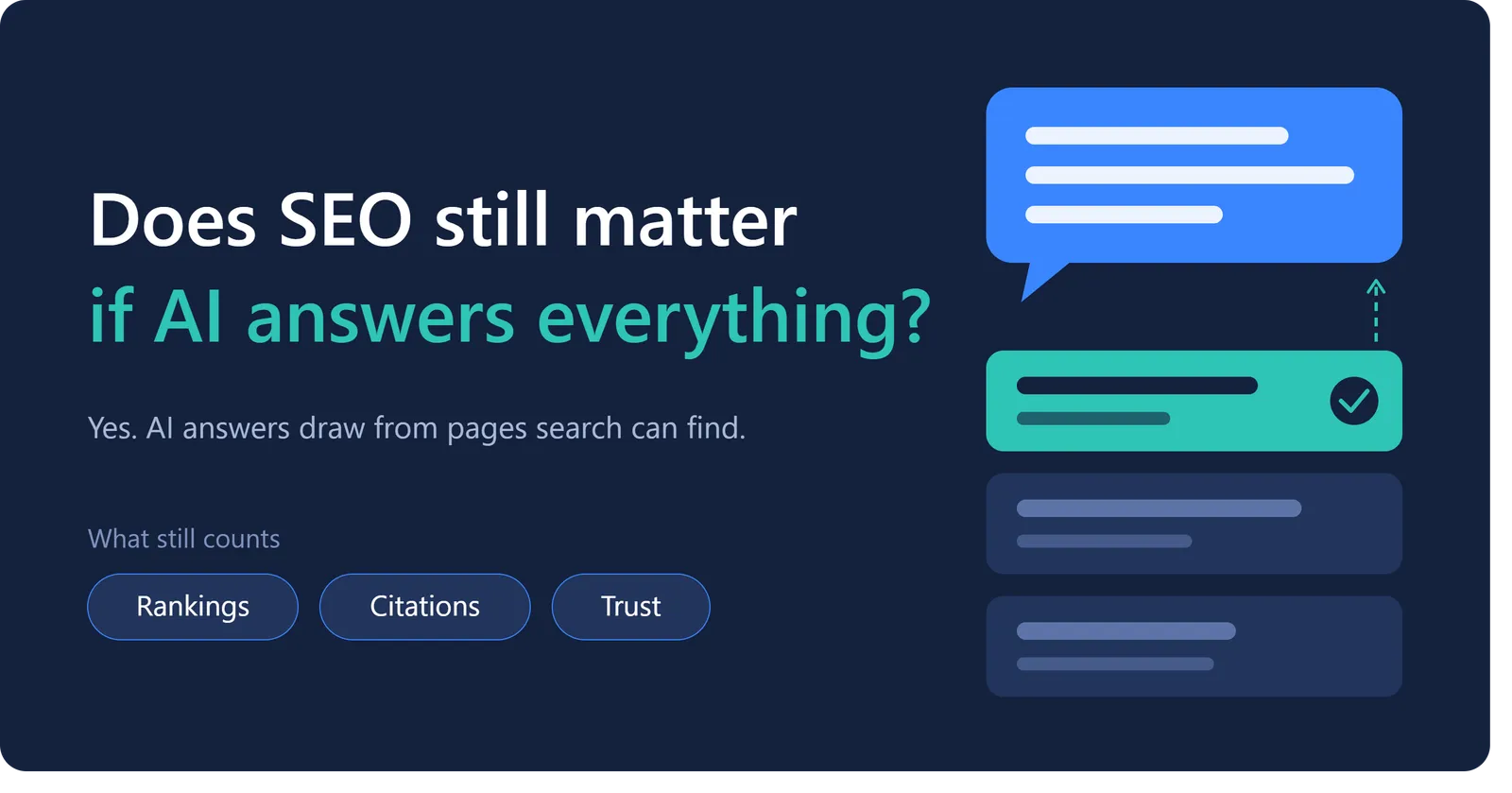
Very much so, and there is plenty of evidence to demonstrate this. Whilst AI doesn’t conjure up information from a blank canvas, Google AI Overviews predominantly utilise already ranked web pages.
Likewise, ChatGPT, Perplexity and Gemini all perform current web searches and reference outcomes. Again, if a page cannot be crawled, indexed and interpreted, then it will not be referenced. Conventional SEO therefore continues to underpin generative AI.
Furthermore, there is substantial value in being referenced. From the same Seer data, brands referenced in AI Overviews achieved two to five times higher organic CTRs than those which were ranked, but not referenced.
In 2025, for informational search terms, referenced brands achieved an average organic CTR of 2.07% compared to 0.94% for non-referenced brands. Although Seer is careful to emphasise that this does not necessarily prove referencing causes increased CTR, as stronger brands are more likely to be referenced. Nonetheless, the difference is significant and cannot be overlooked.
Moreover, consumers referred to a brand via AI also convert better than those reaching it via organic search. Shopify Q2 2026 data indicated that customers referred via AI converted around 80% better and in more in-depth sectors around double that of organic referral customers.
However, organic search still produced a greater overall number of sessions. Both referral types are therefore important, and neither can function without good fundamental SEO. Whilst the importance of SEO has not changed, the nature of ‘good’ SEO has.
What Managed SEO Services Should Still be Doing Well?
Whilst some aspects of legacy SEO are now even more important, agencies which are overly preoccupied with AI innovation can be misguided if they fail to address below.
a. Technical access for every crawler, not just Googlebot
Although Googlebot can interpret JavaScript to a reasonable degree, many AI crawlers cannot. If a site utilises client-side rendering for key information, then a model may perceive it as an empty page even though high-quality content is present.
Indeed, this is currently the most significant technical concern for optimising AI referencing. Unlike llms.txt files and schema, which individually have limited impact, this area receives far less attention.
Good managed SEO should investigate what information GPTBot, ClaudeBot, PerplexityBot, and Google-Extended are able to access; ensure that robots.txt does not inadvertently prevent AI crawlers from accessing a site; and then embed key content within server-rendered HTML.
b. Content that answers before it sells
AI identifies and isolates key information such as definitions, statistics, processes and contrasts. Pages which state a succinct answer in the first couple of sentences and then add further detail will be analysed in this manner. However, pages which begin with three or more brand background paragraphs will not be analysed.
This is not robotic writing. Instead, it is analogous to how a perceptive consultant would communicate, firstly providing information, then explaining and finally adding caveats.
c. Topical depth over keyword coverage
Historically, it was sufficient to rank for one keyword to succeed for a search term. An AI Overview may now amalgamate six sub-questions and provide a single response. Should your website lack information on sub-topics such as cost, time, and risks, then another brand that does contain this information will become the more informative reference point.
d. Links that carry real authority
As previously noted, backlinks continue to influence search positions, and this, in turn, affects AI referencing. Yet Ahrefs’ research of 75,000 brands highlighted that there was only a weak relationship (0.218) between the quantity of a brand’s backlinks and AI Overview referencing.
Of all elements analysed, the strongest correlation was found for branded web mentions (0.664). Brand-specific anchor text was also highly influential (0.527).
Therefore, securing brand mentions on authoritative sectoral websites using either branded or descriptive anchors is substantially more valuable than obtaining numerous backlinks from directories. Volumetric link propositions are increasingly outdated.
What a Modern Program Adds on Top?
Here's where managed SEO services in 2026 separate into two groups. One adds ‘GEO’ to an offering and makes no additional changes. The other goes beyond.
a. AI visibility tracking
Without measurement, there can be no management. A robust managed SEO service will analyse how frequently a brand is referenced and linked to on ChatGPT, Gemini and Google, as well as the statements made about it. There are now tools including Ahrefs Brand Radar, Semrush’s AI suite and Profound which enable this assessment. Such facilities were not available two years ago.
This is not for ego. AI outputs are volatile. A brand may be referenced in 90% of ChatGPT responses to a search term relating to a sector in the spring yet by autumn, this figure may have fallen to the 60s. Crucially, if there is no measurement in place, then this will often go unnoticed until conversion rates begin to suffer.
b. Earned mentions as an SEO deliverable
Considering the extent to which AI utilises external references, off-line brand mentions are no longer solely a PR concern. AI values mentions in areas such as G2 and Clutch reviews, sectoral press articles, Reddit discussions, comparative reports and Wikipedia (where appropriate) when recommending brands. Internal content communicates a brand’s self-perception. Earned content reveals how a brand is perceived externally.
An agency which separates out digital PR and review creation into distinct service lines, and for which different individuals have differing aims, will struggle in this area. A cohesive strategy is essential.
c. Entity clarity
AI operates in terms of entities, businesses, people and products and the connections between them. If a brand’s name, history, personnel and service provision differ between a website, LinkedIn, Crunchbase, review sites and directories, then models will either speculate or ignore a brand. Although far from glamorous, entity harmonisation is extremely effective.
d. Narrative monitoring
Most SEO agencies completely overlook this. An AI may reference a brand and provide information within a wider context which includes, for example, an outdated legal case against it, a contentious Reddit post or a rival’s comparison page.
Whereas historically, controlling page one search results was seen as synonymous with SEO excellence, AI can now autonomously create page one, and this cannot be edited.
For this reason, the boundary between SEO and reputation management is becoming increasingly blurred. Businesses such as NetReputation now consider AI search optimisation and reputation management to be one field. AI referencing is both a referencing and trust issue for a brand.
How to Tell if your SEO Provider Has Kept Up?
During your next review meeting, probe your provider on the following points. This will rapidly determine whether you are effectively being charged for a 2019 offering in 2026.
AI reporting: Which AI platforms does your provider analyse for our brand? And how many search prompts are analysed? Vague responses or merely a screenshot of one ChatGPT prompt should raise concerns.
Click context: To what extent is our changing traffic impacted by AI Overviews and/or ranking evolution? Reputable agencies analyse Search Console data to determine this, dividing it into terms which do and do not result in AI features.
Crawler testing: Has your provider assessed what AI crawlers see when visiting our core pages? If not, ask them to.
Mention strategy: What is your approach to securing brand mentions on sites referenced by AI for our sector? Merely stating a figure for the number of links to be acquired is inadequate.
Business metrics: Alongside ranking and traffic, what business-related data does your provider analyse? Ideally, this should include lead generation, assisted conversions, branded search, and AI share of voice.
Should the majority of responses relate to "we're exploring that," then you have your answer.
What to Stop Paying For?
Several service lines should be subjected to rigorous scrutiny when reviewing a managed SEO retainer.
Rank tracking as the headline metric: Although search positions are still pertinent as an input, they do not reflect the above-mentioned click reduction and should not therefore act as the primary performance indicator.
High-volume, low-quality link packages: As noted above, the pledge to supply ‘50 per month’ links has always been a poor one. In the light of referencing versus backlink data, such propositions are almost valueless for optimising AI referencing.
Thin content at scale: Regularly publishing 800-word content which simply reiterates existing high-ranking information does not effectively establish sectoral authority. Indeed, Google undervalues this and AI tools ignore it. Two high-quality pieces of content outweigh eight average ones.
Schema as a magic fix: Although structured data assists search engines in analysing web pages, it will not transform a low-quality page into one that is referenced. Therefore, view schema as good practice, but not strategy.
The Right Way to Think About Budget!
Whilst increased expenditure does not automatically occur as the scope of managed SEO develops, in most cases funds will be reallocated.
Move money away from volumetric links and general blog provision and towards technical enhancement, focused content, earned media and multi-platform AI referencing analysis.
Timeframes for seeing outcomes will also differ. Due to the live search functionality of many AI tools, technical enhancement can influence AI referencing relatively swiftly.
Content enhancement generally takes 1-3 months to impact. Earned media, review development, and entity refinement build up over 3-6 months (or longer).
Currently, the leading managed SEO services do not concentrate on search positions. Rather, they endeavour to ascertain firstly whether a brand is referenced when a machine is queried about a sector, and secondly, whether the information given about it is accurate.
Again, search positions can be a route to achieving these aims but are by no means the end-point.
Frequently Asked Questions
a. What are managed SEO services?
Managed SEO is ongoing search optimisation undertaken by an external agency or expert, typically every month. It commonly comprises technical, content, on-page and linking services and reporting. From 2026, superior managed SEO also analyses and enhances a brand’s inclusion in AI search results on Google, ChatGPT, Gemini and Perplexity.
b. Is SEO still worth it with AI Overviews reducing clicks?
Yes. As AI bases its information on already ranked and crawled web pages, SEO remains fundamental to optimising AI referencing. Brands referenced in AI Overviews achieve two to five times higher CTRs than non-referenced brands, according to Seer Interactive data. Optimisation must therefore focus not only on search positioning, but also on becoming referenced.
c. What's the difference between SEO and GEO?
SEO centres on obtaining good search results for a brand. GEO (generative engine optimisation) aims to secure brand referencing and linking within AI search results. The disciplines are closely interlinked as AI utilises indexed online information. Moreover, GEO introduces earned referencing, entity precision, informative content, and multi-platform brand referencing analysis on top of SEO.
d. How do I measure SEO success if rankings aren't enough?
In tandem with search positions, analyse organic search traffic broken down into terms that do and do not result in AI features. In addition, assess branded search volume, along with organic and AI referral lead generation and conversions. Finally, analyse share of voice for a defined set of prompts within AI. Although search positions should still be included within reporting, they must not be allowed to dominate.
e. Do backlinks still matter for AI search?
Yes, but to a lesser extent than most backlink propositions suggest. Ahrefs’ research of 75,000 brands found that there was only a weak correlation (0.218) between the number of backlinks to a brand and AI Overview referencing. Of all analysed elements, the strongest relationship was identified for branded web mentions (0.664). Brand-specific anchor text was also highly influential (0.527). High-quality brand mentions on authoritative sector websites are thus much more valuable than large numbers of links from low-authority sites for both search positioning and AI referencing.
f. How long does it take to see results from AI-focused SEO?
Technical enhancement can impact AI referencing relatively quickly, as many AI tools conduct live web searches. Content enhancement generally takes 1-3 months to affect referencing. Earned media, reviews, and entity refinements accumulate over 3-6 months (or more). As already discussed, competitive search positioning continues to evolve over a similar 3-6 month period.